 Blog
 Podcast
 Unterstützung
 Kunden-Login


5 Mitgliedschaftsexperten teilen ihre Top-Strategien zur Mitgliederbindung
Seien wir ehrlich, eine der größten Herausforderungen beim Betrieb einer Mitgliederseite oder eines Abonnementgeschäfts ist die Mitgliederbindung.
Auch wenn Sie vielleicht denken, dass es die harte Arbeit ist, jemanden dazu zu bringen, Ihrer Mitgliedschaft beizutreten, so ist dies doch nur die halbe Miete (und das könnte die einfach Hälfte).
The real work begins once someone signs up for your membership or becomes a subscriber. Now you have to deliver the value they are expecting. It won’t take long for your new members to see whether or not you’ve got the goods and can actually fulfill the promises you made in your marketing.
Here’s the thing, if you can’t retain a member, you will never truly reap the rewards of the membership business model: consistent and compounding recurring revenue.
In order to help you with your own member retention strategy, we’ve compiled perspectives and advice from five different membership and subscription business experts. After you read this article, we think you’ll have a much better understand of what it takes to retain your members.
Geben Sie Ihren Mitgliedern einen guten Grund, Mitglied zu werden (und einen besseren, zu bleiben)

Luke Ward hat fast 10 Jahre lang eine Website für Musikunterricht aufgebaut und weiterentwickelt, die BassGorilla. Er arbeitete hart daran, sein ursprüngliches Angebot für seine potenziellen Kunden attraktiv zu gestalten. Aber er arbeitete noch härter daran, seinen Mitgliedern einen zwingenden Grund zu geben, in seiner Mitgliedschaft zu bleiben und sich in der Gemeinschaft zu engagieren.

“You’ve got to have a very solid reason why someone would want to pay you a recurring subscription every month. At BassGorilla, we worked on our offer and the community aspect, and eventually it started working really well.
We worked hard on what our members had access to. If they only have access to courses that’s one thing. But, if they have access to a community where they can get to know like-minded people, ask questions, things like that, that’s another thing entirely. Part of this was that we introduced a music feedback section of the community where people could post their tracks or works in progress and get feedback from other members to help them improve.
Another thing we did to improve our offer was I reached out to a lot of music software companies and asked them if they’d be willing to offer some kind of discount or coupon code for our community of members. I got about 15 of them agree to that. That’s just another part of the offer that makes it more appealing, because if you can save money on music plugins, then that would end up more than covering the cost of your membership in many cases.
Fostering a really solid community is a great thing to do. Once you have that community in place, you’re able to get feedback from them on what’s not so good about your site, what is great about your site, but also what kind of content they want.
So, when you’re making content based on what your members are asking for, then it’s going to appeal to more and more similar people who are in that niche. So, I think that the community aspect of having a membership site is a really solid one and it really helped to create a very, very solid community for us.”
Erfahren Sie mehr von Luke in dieser Folge unseres Podcasts: Wie man eine Mitgliedschaftsseite startet, ausbaut und verkauft
Gestalten Sie Ihr Onboarding zur Unterstützung der Mitgliederbindung

Amanda Northcutt ist eine Beraterin für Umsatzstrategien für Online-Unternehmen mit wiederkehrenden Umsatzmodellen. Im Klartext: Sie hilft Mitgliedschafts- und Abonnementunternehmen, mehr Geld zu verdienen. Sie ist unglaublich klug und verfolgt einen praktischen, systematischen Ansatz zur Gewinnsteigerung.
Für sie ist einer der wichtigsten Faktoren bei der Erhöhung der Mitgliederbindung die Onboarding-Strategie. Die Art und Weise, wie Sie Ihre neuen Mitglieder willkommen heißen und sie an Ihre Mitgliedschaft gewöhnen, kann einen großen Einfluss darauf haben, ob sie langfristig bei Ihnen bleiben oder nicht.
"Onboarding ist so entscheidend. Jetzt, wo jemand in Ihrer Mitgliedschaft ist, wollen Sie ihn so schnell wie möglich dazu bringen, die Vorteile zu erkennen. Sobald Ihre Mitglieder die Vorteile kennen, die sie durch die Funktionen innerhalb Ihrer Mitgliedschaft erhalten können, lernen sie beim Onboarding, wie sie diese versprochenen Vorteile tatsächlich erkennen und erreichen können.
For example, if you know that the most important thing a new member can do or the biggest indicator of retention is participating in your discussion forum, really early on in your onboarding, you’re going to want to make it super easy for someone to jump in and introduce themselves, and start talking to other members.
Here’s another example: if you know that starting a specific course is a key retention behavior, you want to point people towards starting that course very early on or consuming XYZ pieces of content. So, you have to know how your current members are using and getting the most benefit from your site, then turn that around and use that information and social proof in your marketing and then onboarding.
One great member retention tactic that I’ve seen employed on multiple membership sites is sending out a weekly or twice monthly or once a month email that says, ‘Hey, here’s what’s going on in the discussion forum. Here’s what content we put out. Here’s the results some of our members are getting.’ Tease what’s coming up next.
Do this especially in your onboarding sequence. I think it’s really important to tease future content especially if there’s an exit ramp at the end of the 30-day trial. A lot of people jump off there. So, you’ve got to tease future content to keep them, or to get that first payment recognized, and then you go from there obviously.”
Erfahren Sie mehr von Amanda in dieser Folge unseres Podcasts: Meisterung wiederkehrender Umsätze: Vom Startup zum 8-stelligen Betrag
Verstehen Sie Abwanderung: Die Nemesis der Mitgliedererhaltung

Carl Gold ist der leitende Datenwissenschaftler von Zuora - eine Softwareplattform, die Fortune-500-Unternehmen bei der Verwaltung nahezu aller Aspekte ihres Abonnement- und Mitgliedschaftsgeschäfts unterstützt.
Als Datenwissenschaftler hat Carl die einzigartige Möglichkeit, die Mitgliedschafts- und Abonnementbranche als Ganzes von einem sehr hohen Standpunkt aus zu betrachten. Im Laufe der Jahre hat er die wichtigsten Trends in der Branche erkannt und verstanden. Aber von allen Dingen, die sich auf ein Geschäft mit wiederkehrenden Einnahmen auswirken können, hat er sich auf das eine Hauptproblem konzentriert, das alle Mitgliedschafts- und Abonnementunternehmen plagt: CHURN.
“The most basic definition is that churn is your customers quitting. And it’s typically in a subscription context. So, there’s an actual cancellation of a subscription. That’s what churn is at the highest level.
If you want to increase the number of customers you have and grow your business, it helps a lot if you’re not losing customers all the time. Churn is a straight drag on your growth. If you’re acquiring 10% new customers every quarter, but you’re churning out 5% then you’re only growing at 5%. It’s simple arithmetic.
Now, there’s specific metrics around churn. One being the standard churn rate: the percentage of your customers that have quit or cancelled in a given period. People typically measure either monthly churn or annual churn.
Many businesses also instead use a revenue base churn calculation, which you can just call revenue churn. It’s the same basic idea. It’s how much revenue of the customers who quit as a percent of the total. Revenue churn is important to understand when your customers pay a wide variety of prices.
There are also different types of churn that people recognize. The most common distinction is between a voluntary and involuntary churn. Although personally, I don’t like the term. When people say involuntary churn, I prefer to call it passive churn.
Definieren wir es: Unfreiwillig oder passiv bedeutet, dass der Kunde nicht bezahlt hat. Dies hat in der Regel mit dem Ausfall der Zahlungskarte zu tun, entweder mit einer ungültigen Kartennummer, einer abgelaufenen Karte oder einem nicht verfügbaren Guthaben. Bei einer passiven Abwanderung sperrt der Dienst den Kunden wegen Nichtbezahlung.
A voluntary churn is more like your classic churn where the customer calls up and says, ‘I’m done.’ Or maybe they do it on the website, they click cancel. That’s a voluntary churn. I don’t like to call the involuntary churns, involuntary. I prefer the term passive because when you say involuntary churn, it’s sort of implies that the customer wanted to stay, but they couldn’t.”
Erfahren Sie mehr von Carl in dieser Folge unseres Podcasts: Wie man mit Daten die Abwanderung bekämpft
Lernen Sie, "ewige Herausforderungen" für Ihre Mitglieder zu lösen
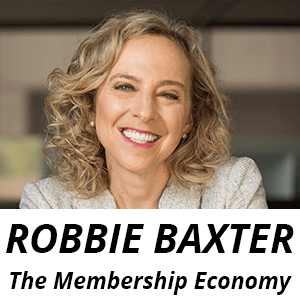
Robbie Baxter ist Experte für Mitgliedschaftsgeschäfte, weltbekannter Keynote-Speaker und Bestsellerautor von Die Mitgliedschaftswirtschaft. Im Laufe ihrer Karriere hat sie Unternehmer, kleine Unternehmen und Fortune-500-Unternehmen beraten. Zu ihren Kunden gehören einige Unternehmen, von denen Sie vielleicht schon gehört haben: Netflix, SurveyMonkey und eBay.
Robbie ist ein echter Experte, wenn es darum geht, Unternehmen zu entwickeln, die in der Lage sind, Kunden zu binden. Ihrer Meinung nach sollte Ihr Plan zur Mitglieder- und Abonnentenbindung eigentlich in die Grundlage Ihres Unternehmens eingebaut sein. Kundenbindung ist weniger eine "Strategie" als vielmehr ein grundlegendes Anliegen, das idealerweise in Ihrem Kernangebot enthalten ist.
“The first thing to think about is this: are you providing enough value that it’s worth more than nothing? That’s the biggest hurdle that it’s worth more than free because there’s so much out there that’s available for free. You really have to start by thinking ‘What do I have that’s worth paying for?’
The second thing to think about is this: is your offering optimized for a subscription? For example, if I’m going to teach you how to tie a tie, it probably wouldn’t justify a subscription. No matter how much you want to tie a tie, once you learn it there’s not much more that you can learn. You’re probably not going to want to talk about it with other people and you’re not going to have ongoing questions.
I see all the time that people have one piece of information, one piece of content, something very narrow and they want to do a subscription. Then they’re surprised when people cancel. In that case, the cancellation is completely justified because they’ve taken all the value out of your subscription that there is to take.
So, step one is to pick a foundational business model and an offering that will actually support people paying you on a month-to-month basis. What type of businesses are those? Anything where the subscriber or member has a what I call a ‘forever challenge.’ Something that’s going to go on for an extended period of time and where the organization or the business can provide a forever promise to justify a long-term relationship.
I have not seen much of correlation between price and retention rates. What I have seen is that the bigger issue is between people thinking that something is valuable and not valuable. They’re less sensitive about the actual specific price, unless the pricing is significant outlier well above $5 to $15 that we see most of the time for content.
There is a clear correlation between perception of value and cancelling and I see a clear correlation between usage and canceling. That’s probably a better thing to track. Are people using it on a regular basis? If they are, they won’t cancel.
That’s why an engagement is a great leading indicator for retention. If people aren’t using your content or using your software on a regular basis in the best way, they’re probably going to cancel. You can also start to see who’s getting the most value in terms of usage.
You can look at what I call the recency, frequency, and depth. When is the last time they logged in? How often do they log in or use your product? Then how deep do they go? Do they use all your features? Do they look at all your content? Do they spend lots of time looking at different things? That’s going to show you who’s getting the most value. Or, that could be an indicator of who is getting the most value.”
Erfahren Sie mehr von Robbie in dieser Folge unseres Podcasts: Der wesentliche Leitfaden für die Preisgestaltung von Mitgliederseiten
Binden Sie Ihre Mitglieder durch persönliches Engagement

Zu guter Letzt in unserer Zusammenstellung von Mitgliedschaftsexperten Teresa Heath-Wareing. Sie ist eine brillante Social-Media-Vermarkterin, Bloggerin, Podcasterin und Unternehmerin. Sie betreibt eine Agentur für digitales Marketing und hat Anfang des Jahres ihre eigene Mitgliederseite gestartet.
Teresa ist es wichtig, ihre Mitglieder zu lieben. Tatsächlich hat sie einige Dinge getan, um ihre Mitglieder in ihrer Gemeinschaft willkommen zu heißen, über die manche Leute im Zeitalter der "Automatisierung" und "Skalierbarkeit" die Augen verdrehen könnten.
Aber das Ergebnis? Sie hat eine engagierte Gemeinschaft voller Menschen, die tiefe persönliche und geschäftliche Beziehungen aufbauen. Und nachdem sie ihre Mitgliedschaft eingeführt hatte, hatte Teresa nur EINE Kündigung. Man kann also mit Fug und Recht behaupten, dass sie ein oder zwei Dinge über Mitgliederbindung weiß. Teresa ist ein großer Fan davon, klein anzufangen, damit Sie die Zeit und Energie haben, sich für Ihre Mitglieder besonders ins Zeug zu legen.
“Why not start your membership with five, ten, or twenty people? There are some great advantages to starting with a small number of members to begin with. If you want to get going with it and you really want to try it, then you really don’t have to wait until you have a massive email list or social media following.
The things that you can do with a smaller group and the learnings that you can take for them and for you are way bigger than you can manage in a larger group. Because when you’re large, there are things that you just actually can’t do because of the size of it. Whereas starting small, I’ve been able to do things that I’d never be able to do in a membership that had 200 members.
For example, when I sold the membership, I said I would do one coaching call per month. But actually, I’ve been doing them every two weeks because I wanted to get to know them and I wanted them to get to know me. I wanted to do some really good quick things and I knew that’s where the value would be. I’ve also thrown in more content for my members than I would normally do.
Another thing I did – which again I could only do because of the size of the group – is that I hand wrote cards to all of them. I will do this again, even if we have more people join. I went and looked at what they did and I tried to write something personal in every single one. And like I said, I wrote everyone. When you start a membership with 30-odd members, it doesn’t sound like a lot but I can tell you, it takes time. But, my members’ response from that was amazing.
Ich schreibe Karten für meine neuen Akademiemitglieder. Ich freue mich sehr darauf, ihnen zu helfen, ihr Geschäft auszubauen 🙂 .
Wenn Sie mehr über die Akademie erfahren möchten, klicken Sie hier - https://t.co/066yqWrlp4 pic.twitter.com/J5wNExNVx9- Teresa Heath-Wareing (@theathwareing) Oktober 9, 2019
Here’s another thing I’ve done – which is going to pay dividends going forward – since starting the membership: one of my team members and I sat here the other day and we literally went through every single member. She essentially did a mini-interview on me about who they were.
I answered questions like: Do they have children? Where do they live? How did they know me? Where did they come from? Did they attend the webinar? Did they miss the webinar? I tried to profile these people because again, before you start this process, you think you know who you’re attracting and you think you know who you want in there.
We literally say, ‘this person is a social media manager, she has a small freelance agency, she has children, she’s trying to manage that, she’s doing this. This guy has a product, this guy has a membership, this person has just launched an online course.’ It’s basically literally going, ‘Okay, that’s who you are.’ But, the other thing that it’s helped with when people come on the call and I go, ‘Hi Bridget! How did the membership go?” or ‘How is your course launch?’ Again, that value for me is huge. If someone remembers details about me, it’s like you care, you care enough to remember. I think stuff like that is super important.”
Erfahren Sie mehr von Teresa in dieser Folge unseres Podcasts: Wie man eine Mitgliedschaftsseite von Anfang bis Ende startet
Einpacken
Wir hoffen, dass Sie nach der Lektüre dieses Artikels ein besseres Verständnis dafür haben, was Sie tun können, um Ihre Mitglieder zu halten.
Wenn Sie mehr von einem der in diesem Beitrag vorgestellten Experten erfahren möchten, empfehlen wir Ihnen, sich unsere ausführlichen Gespräche auf unser podcast.
Do you have any questions or comments about what we covered in this article? Leave us a comment below. We’d love to hear from you.

Blair Williams
Von MemberMouse erstelltes Mitarbeiterkonto




 DE
 EN
 ES
 FR
 PT


