 Blog
 Podcast
 Ayuda
 Acceso de clientes


5 expertos en afiliación comparten sus mejores estrategias para retener socios
Admitámoslo, uno de los mayores retos a los que se enfrentará cuando dirija un sitio de afiliación o un negocio de suscripción es la retención de miembros.
Aunque pueda pensar que conseguir que alguien se afilie a su asociación en primer lugar es el trabajo duro, en realidad es sólo la mitad de la batalla (y eso podría ser el fácil mitad).
The real work begins once someone signs up for your membership or becomes a subscriber. Now you have to deliver the value they are expecting. It won’t take long for your new members to see whether or not you’ve got the goods and can actually fulfill the promises you made in your marketing.
Here’s the thing, if you can’t retain a member, you will never truly reap the rewards of the membership business model: consistent and compounding recurring revenue.
In order to help you with your own member retention strategy, we’ve compiled perspectives and advice from five different membership and subscription business experts. After you read this article, we think you’ll have a much better understand of what it takes to retain your members.
Dé a sus afiliados una buena razón para afiliarse (y una mejor para quedarse)

Durante casi 10 años, Luke Ward creó y desarrolló un sitio web de educación musical llamado BassGorilla. Trabajó duro para que su oferta inicial resultara atractiva a sus posibles clientes. Pero trabajó aún más para dar a sus afiliados una razón de peso para seguir afiliados y participar en la comunidad.

“You’ve got to have a very solid reason why someone would want to pay you a recurring subscription every month. At BassGorilla, we worked on our offer and the community aspect, and eventually it started working really well.
We worked hard on what our members had access to. If they only have access to courses that’s one thing. But, if they have access to a community where they can get to know like-minded people, ask questions, things like that, that’s another thing entirely. Part of this was that we introduced a music feedback section of the community where people could post their tracks or works in progress and get feedback from other members to help them improve.
Another thing we did to improve our offer was I reached out to a lot of music software companies and asked them if they’d be willing to offer some kind of discount or coupon code for our community of members. I got about 15 of them agree to that. That’s just another part of the offer that makes it more appealing, because if you can save money on music plugins, then that would end up more than covering the cost of your membership in many cases.
Fostering a really solid community is a great thing to do. Once you have that community in place, you’re able to get feedback from them on what’s not so good about your site, what is great about your site, but also what kind of content they want.
So, when you’re making content based on what your members are asking for, then it’s going to appeal to more and more similar people who are in that niche. So, I think that the community aspect of having a membership site is a really solid one and it really helped to create a very, very solid community for us.”
Luke nos cuenta más cosas en este episodio de nuestro podcast: Cómo crear, desarrollar y vender un sitio web de socios
Diseñe su incorporación para favorecer la retención de socios

Amanda Northcutt es consultora de estrategias de ingresos para negocios online con modelos de ingresos recurrentes. En pocas palabras, ayuda a las empresas de suscripción y afiliación a ganar más dinero. Es increíblemente inteligente y adopta un enfoque práctico y sistemático para aumentar los beneficios.
Para ella, uno de los factores más importantes para aumentar la retención de socios es la estrategia de incorporación. La forma en que se da la bienvenida a los nuevos afiliados y se les integra en la organización puede influir enormemente en su permanencia a largo plazo.
"La incorporación es fundamental. Ahora que alguien está dentro de su programa de afiliación, quiere conseguir que valore el reconocimiento lo antes posible. Una vez que los afiliados conocen los beneficios que pueden obtener de las funciones de su afiliación, la incorporación les enseña a reconocer y conseguir realmente los beneficios prometidos.
For example, if you know that the most important thing a new member can do or the biggest indicator of retention is participating in your discussion forum, really early on in your onboarding, you’re going to want to make it super easy for someone to jump in and introduce themselves, and start talking to other members.
Here’s another example: if you know that starting a specific course is a key retention behavior, you want to point people towards starting that course very early on or consuming XYZ pieces of content. So, you have to know how your current members are using and getting the most benefit from your site, then turn that around and use that information and social proof in your marketing and then onboarding.
One great member retention tactic that I’ve seen employed on multiple membership sites is sending out a weekly or twice monthly or once a month email that says, ‘Hey, here’s what’s going on in the discussion forum. Here’s what content we put out. Here’s the results some of our members are getting.’ Tease what’s coming up next.
Do this especially in your onboarding sequence. I think it’s really important to tease future content especially if there’s an exit ramp at the end of the 30-day trial. A lot of people jump off there. So, you’ve got to tease future content to keep them, or to get that first payment recognized, and then you go from there obviously.”
Amanda nos cuenta más cosas en este episodio de nuestro podcast: Dominar los ingresos recurrentes: De la startup a las 8 cifras
Entender el churn: La némesis de la retención de socios

Carl Gold es el Científico Jefe de Datos de Zuora - una plataforma de software que ayuda a las empresas de Fortune 500 a gestionar casi todos los aspectos de sus negocios de suscripción y afiliación.
Como científico de datos, Carl tiene la oportunidad única de ver el sector de las afiliaciones y suscripciones en su conjunto desde un punto de vista muy elevado. A lo largo de los años, ha llegado a identificar y comprender las principales tendencias del sector. Pero de todas las cosas que pueden afectar a un negocio de ingresos recurrentes, se ha centrado en el principal problema que afecta a todos los negocios de afiliación y suscripción: GIRAR.
“The most basic definition is that churn is your customers quitting. And it’s typically in a subscription context. So, there’s an actual cancellation of a subscription. That’s what churn is at the highest level.
If you want to increase the number of customers you have and grow your business, it helps a lot if you’re not losing customers all the time. Churn is a straight drag on your growth. If you’re acquiring 10% new customers every quarter, but you’re churning out 5% then you’re only growing at 5%. It’s simple arithmetic.
Now, there’s specific metrics around churn. One being the standard churn rate: the percentage of your customers that have quit or cancelled in a given period. People typically measure either monthly churn or annual churn.
Many businesses also instead use a revenue base churn calculation, which you can just call revenue churn. It’s the same basic idea. It’s how much revenue of the customers who quit as a percent of the total. Revenue churn is important to understand when your customers pay a wide variety of prices.
There are also different types of churn that people recognize. The most common distinction is between a voluntary and involuntary churn. Although personally, I don’t like the term. When people say involuntary churn, I prefer to call it passive churn.
Vamos a definirlo: Involuntario o pasivo significa que el cliente no ha pagado. Esto suele tener que ver con el fallo de la tarjeta de pago, ya sea un número de tarjeta no válido, una tarjeta caducada o un saldo no disponible. Por lo tanto, en un churn pasivo, el servicio corta al cliente por falta de pago.
A voluntary churn is more like your classic churn where the customer calls up and says, ‘I’m done.’ Or maybe they do it on the website, they click cancel. That’s a voluntary churn. I don’t like to call the involuntary churns, involuntary. I prefer the term passive because when you say involuntary churn, it’s sort of implies that the customer wanted to stay, but they couldn’t.”
Conozca más detalles de Carl en este episodio de nuestro podcast: Cómo combatir la pérdida de clientes con datos
Aprenda a resolver los "retos de siempre" de sus afiliados
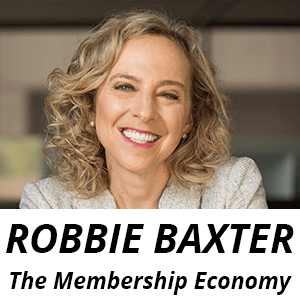
Robbie Baxter es una experta en negocios de afiliación, conferenciante de renombre mundial y autora del best-seller La economía de los afiliados. A lo largo de su carrera, ha asesorado a emprendedores, pequeñas empresas y compañías de Fortune 500. Entre sus clientes se encuentran algunas empresas de las que quizá haya oído hablar. Entre sus clientes figuran algunas empresas de las que quizá haya oído hablar: Netflix, SurveyMonkey y eBay.
Robbie es una auténtica experta en el diseño de empresas preparadas para retener a los clientes. Para ella, el plan de retención de socios y suscriptores debe estar integrado en la base de la empresa. La retención es menos una "estrategia" y más una preocupación fundamental que se aborda idealmente en su oferta principal.
“The first thing to think about is this: are you providing enough value that it’s worth more than nothing? That’s the biggest hurdle that it’s worth more than free because there’s so much out there that’s available for free. You really have to start by thinking ‘What do I have that’s worth paying for?’
The second thing to think about is this: is your offering optimized for a subscription? For example, if I’m going to teach you how to tie a tie, it probably wouldn’t justify a subscription. No matter how much you want to tie a tie, once you learn it there’s not much more that you can learn. You’re probably not going to want to talk about it with other people and you’re not going to have ongoing questions.
I see all the time that people have one piece of information, one piece of content, something very narrow and they want to do a subscription. Then they’re surprised when people cancel. In that case, the cancellation is completely justified because they’ve taken all the value out of your subscription that there is to take.
So, step one is to pick a foundational business model and an offering that will actually support people paying you on a month-to-month basis. What type of businesses are those? Anything where the subscriber or member has a what I call a ‘forever challenge.’ Something that’s going to go on for an extended period of time and where the organization or the business can provide a forever promise to justify a long-term relationship.
I have not seen much of correlation between price and retention rates. What I have seen is that the bigger issue is between people thinking that something is valuable and not valuable. They’re less sensitive about the actual specific price, unless the pricing is significant outlier well above $5 to $15 that we see most of the time for content.
There is a clear correlation between perception of value and cancelling and I see a clear correlation between usage and canceling. That’s probably a better thing to track. Are people using it on a regular basis? If they are, they won’t cancel.
That’s why an engagement is a great leading indicator for retention. If people aren’t using your content or using your software on a regular basis in the best way, they’re probably going to cancel. You can also start to see who’s getting the most value in terms of usage.
You can look at what I call the recency, frequency, and depth. When is the last time they logged in? How often do they log in or use your product? Then how deep do they go? Do they use all your features? Do they look at all your content? Do they spend lots of time looking at different things? That’s going to show you who’s getting the most value. Or, that could be an indicator of who is getting the most value.”
Aprenda más de Robbie en este episodio de nuestro podcast: Guía esencial para fijar los precios de los sitios web de afiliación
Retenga a sus afiliados mediante un compromiso personal

Por último, pero no por ello menos importante, nuestra ronda de expertos en afiliación incluye a Teresa Heath-Wareing. Es una brillante comercializadora de redes sociales, bloguera, podcaster y empresaria. Dirige una agencia de marketing digital y a principios de este año lanzó su propio sitio de membresía.
A Teresa le encanta querer a sus miembros. De hecho, ha hecho algunas cosas para dar la bienvenida a sus miembros a su comunidad ante las que algunas personas podrían poner los ojos en blanco en esta era de la "automatización" y la "escalabilidad".
¿Y el resultado? Tiene una comunidad comprometida llena de personas que establecen profundas relaciones personales y comerciales. Y después de lanzar su afiliación, Teresa sólo tuvo UNA cancelación. Así que creemos que es justo decir que sabe un par de cosas sobre la retención de miembros. Teresa es una gran fan de empezar poco a poco para tener el tiempo y la energía necesarios para hacer un esfuerzo adicional por sus miembros.
“Why not start your membership with five, ten, or twenty people? There are some great advantages to starting with a small number of members to begin with. If you want to get going with it and you really want to try it, then you really don’t have to wait until you have a massive email list or social media following.
The things that you can do with a smaller group and the learnings that you can take for them and for you are way bigger than you can manage in a larger group. Because when you’re large, there are things that you just actually can’t do because of the size of it. Whereas starting small, I’ve been able to do things that I’d never be able to do in a membership that had 200 members.
For example, when I sold the membership, I said I would do one coaching call per month. But actually, I’ve been doing them every two weeks because I wanted to get to know them and I wanted them to get to know me. I wanted to do some really good quick things and I knew that’s where the value would be. I’ve also thrown in more content for my members than I would normally do.
Another thing I did – which again I could only do because of the size of the group – is that I hand wrote cards to all of them. I will do this again, even if we have more people join. I went and looked at what they did and I tried to write something personal in every single one. And like I said, I wrote everyone. When you start a membership with 30-odd members, it doesn’t sound like a lot but I can tell you, it takes time. But, my members’ response from that was amazing.
Escribiendo tarjetas para mis nuevos miembros de la academia. Estoy súper emocionada por ayudarles a hacer crecer sus negocios 🙂 .
Si desea más información sobre la academia, haga clic aquí - https://t.co/066yqWrlp4 pic.twitter.com/J5wNExNVx9- Teresa Heath-Wareing (@theathwareing) 9 de octubre de 2019
Here’s another thing I’ve done – which is going to pay dividends going forward – since starting the membership: one of my team members and I sat here the other day and we literally went through every single member. She essentially did a mini-interview on me about who they were.
I answered questions like: Do they have children? Where do they live? How did they know me? Where did they come from? Did they attend the webinar? Did they miss the webinar? I tried to profile these people because again, before you start this process, you think you know who you’re attracting and you think you know who you want in there.
We literally say, ‘this person is a social media manager, she has a small freelance agency, she has children, she’s trying to manage that, she’s doing this. This guy has a product, this guy has a membership, this person has just launched an online course.’ It’s basically literally going, ‘Okay, that’s who you are.’ But, the other thing that it’s helped with when people come on the call and I go, ‘Hi Bridget! How did the membership go?” or ‘How is your course launch?’ Again, that value for me is huge. If someone remembers details about me, it’s like you care, you care enough to remember. I think stuff like that is super important.”
Teresa nos cuenta más cosas en este episodio de nuestro podcast: Cómo lanzar un sitio de afiliación de principio a fin
Conclusión
Después de leer este artículo, esperamos que comprenda mejor lo que puede hacer para retener mejor a sus afiliados.
Si quiere saber más de cualquiera de los expertos que aparecen en este artículo, le recomendamos que escuche nuestras conversaciones en profundidad en nuestro podcast.
Do you have any questions or comments about what we covered in this article? Leave us a comment below. We’d love to hear from you.


Blair Williams
Cuenta de empleado creada por MemberMouse




 ES
 EN
 DE
 FR
 PT


