 Blog
 Podcast
 Soutien
 Connexion client


5 experts de l'adhésion partagent leurs meilleures stratégies de fidélisation des membres
Ne nous voilons pas la face, l'un des plus grands défis que vous rencontrerez en gérant un site d'adhésion ou une entreprise d'abonnement est la fidélisation des membres.
Bien que vous puissiez penser que le fait d'amener quelqu'un à adhérer à votre organisation est le plus difficile, ce n'est en réalité que la moitié de la bataille (et c'est peut-être la moitié de la bataille qui est la plus difficile). facile moitié).
The real work begins once someone signs up for your membership or becomes a subscriber. Now you have to deliver the value they are expecting. It won’t take long for your new members to see whether or not you’ve got the goods and can actually fulfill the promises you made in your marketing.
Here’s the thing, if you can’t retain a member, you will never truly reap the rewards of the membership business model: consistent and compounding recurring revenue.
In order to help you with your own member retention strategy, we’ve compiled perspectives and advice from five different membership and subscription business experts. After you read this article, we think you’ll have a much better understand of what it takes to retain your members.
Donnez à vos membres une bonne raison d'adhérer (et une meilleure raison de rester)

Pendant près de 10 ans, Luke Ward a créé et développé un site d'adhésion pour l'enseignement de la musique appelé BassGorilla. Il a travaillé dur pour rendre son offre initiale attrayante pour ses clients potentiels. Mais il a travaillé encore plus dur pour donner à ses membres une raison impérieuse de rester membres et de s'impliquer dans la communauté.

“You’ve got to have a very solid reason why someone would want to pay you a recurring subscription every month. At BassGorilla, we worked on our offer and the community aspect, and eventually it started working really well.
We worked hard on what our members had access to. If they only have access to courses that’s one thing. But, if they have access to a community where they can get to know like-minded people, ask questions, things like that, that’s another thing entirely. Part of this was that we introduced a music feedback section of the community where people could post their tracks or works in progress and get feedback from other members to help them improve.
Another thing we did to improve our offer was I reached out to a lot of music software companies and asked them if they’d be willing to offer some kind of discount or coupon code for our community of members. I got about 15 of them agree to that. That’s just another part of the offer that makes it more appealing, because if you can save money on music plugins, then that would end up more than covering the cost of your membership in many cases.
Fostering a really solid community is a great thing to do. Once you have that community in place, you’re able to get feedback from them on what’s not so good about your site, what is great about your site, but also what kind of content they want.
So, when you’re making content based on what your members are asking for, then it’s going to appeal to more and more similar people who are in that niche. So, I think that the community aspect of having a membership site is a really solid one and it really helped to create a very, very solid community for us.”
Luke nous en dit plus dans cet épisode de notre podcast : Comment lancer, développer et vendre un site d'adhésion
Concevoir l'accueil des nouveaux arrivants pour favoriser la fidélisation des membres

Amanda Northcutt est consultante en stratégie de revenus pour les entreprises en ligne ayant des modèles de revenus récurrents. En clair, elle aide les entreprises d'adhésion et d'abonnement à gagner plus d'argent. Elle est incroyablement intelligente et adopte une approche pratique et systématique pour augmenter les profits.
Pour elle, l'un des facteurs les plus importants pour améliorer la fidélisation des membres est votre stratégie d'accueil. La façon dont vous accueillez vos nouveaux membres et dont vous les familiarisez avec votre organisation peut avoir un impact considérable sur leur fidélité à long terme.
"L'intégration est essentielle. Une fois que quelqu'un est entré dans votre système d'affiliation, vous voulez qu'il reconnaisse sa valeur le plus rapidement possible. Une fois que vos membres connaissent les avantages qu'ils peuvent tirer des fonctions de votre adhésion, l'onboarding leur apprend à reconnaître et à obtenir les avantages promis.
For example, if you know that the most important thing a new member can do or the biggest indicator of retention is participating in your discussion forum, really early on in your onboarding, you’re going to want to make it super easy for someone to jump in and introduce themselves, and start talking to other members.
Here’s another example: if you know that starting a specific course is a key retention behavior, you want to point people towards starting that course very early on or consuming XYZ pieces of content. So, you have to know how your current members are using and getting the most benefit from your site, then turn that around and use that information and social proof in your marketing and then onboarding.
One great member retention tactic that I’ve seen employed on multiple membership sites is sending out a weekly or twice monthly or once a month email that says, ‘Hey, here’s what’s going on in the discussion forum. Here’s what content we put out. Here’s the results some of our members are getting.’ Tease what’s coming up next.
Do this especially in your onboarding sequence. I think it’s really important to tease future content especially if there’s an exit ramp at the end of the 30-day trial. A lot of people jump off there. So, you’ve got to tease future content to keep them, or to get that first payment recognized, and then you go from there obviously.”
Amanda nous en dit plus dans cet épisode de notre podcast : Maîtriser les revenus récurrents : De la startup à l'entreprise à 8 chiffres
Comprendre le désabonnement : L'ennemi de la fidélisation des membres

Carl Gold est le Chief Data Scientist de Zuora - une plateforme logicielle qui aide les entreprises du classement Fortune 500 à gérer presque tous les aspects de leurs activités d'abonnement et d'adhésion.
En tant que data scientist, Carl a l'opportunité unique d'observer le secteur de l'adhésion et de l'abonnement dans son ensemble d'un point de vue très élevé. Au fil des ans, il en est venu à identifier et à comprendre les principales tendances du secteur. Mais parmi toutes les choses qui peuvent avoir un impact sur une entreprise à revenus récurrents, il s'est concentré sur un problème majeur qui touche toutes les entreprises d'adhésion et d'abonnement : LE CHURNE.
“The most basic definition is that churn is your customers quitting. And it’s typically in a subscription context. So, there’s an actual cancellation of a subscription. That’s what churn is at the highest level.
If you want to increase the number of customers you have and grow your business, it helps a lot if you’re not losing customers all the time. Churn is a straight drag on your growth. If you’re acquiring 10% new customers every quarter, but you’re churning out 5% then you’re only growing at 5%. It’s simple arithmetic.
Now, there’s specific metrics around churn. One being the standard churn rate: the percentage of your customers that have quit or cancelled in a given period. People typically measure either monthly churn or annual churn.
Many businesses also instead use a revenue base churn calculation, which you can just call revenue churn. It’s the same basic idea. It’s how much revenue of the customers who quit as a percent of the total. Revenue churn is important to understand when your customers pay a wide variety of prices.
There are also different types of churn that people recognize. The most common distinction is between a voluntary and involuntary churn. Although personally, I don’t like the term. When people say involuntary churn, I prefer to call it passive churn.
Définissons-le : Involontaire ou passif signifie que le client n'a pas payé. Cela est généralement lié à la défaillance de la carte de paiement, soit un numéro de carte invalide, une carte expirée ou un solde indisponible. Ainsi, dans le cas d'un désabonnement passif, le service coupe le client pour défaut de paiement.
A voluntary churn is more like your classic churn where the customer calls up and says, ‘I’m done.’ Or maybe they do it on the website, they click cancel. That’s a voluntary churn. I don’t like to call the involuntary churns, involuntary. I prefer the term passive because when you say involuntary churn, it’s sort of implies that the customer wanted to stay, but they couldn’t.”
Carl nous en dit plus dans cet épisode de notre podcast : Comment lutter contre le désabonnement grâce aux données
Apprenez à résoudre les "défis permanents" de vos membres
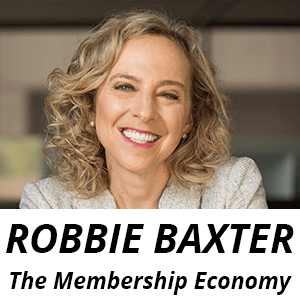
Robbie Baxter est un expert en commerce d'adhésion, un conférencier de renommée mondiale et l'auteur à succès de L'économie de l'adhésion. Tout au long de sa carrière, elle a conseillé des entrepreneurs, des petites entreprises et des sociétés figurant au classement Fortune 500. Elle compte parmi ses clients quelques entreprises dont vous avez peut-être entendu parler : Netflix, SurveyMonkey et eBay.
Robbie est une véritable experte lorsqu'il s'agit de concevoir des entreprises capables de fidéliser leurs clients. Pour elle, votre plan de fidélisation des membres et des abonnés devrait en fait être intégré dans les fondements de votre entreprise. La fidélisation n'est pas tant une "stratégie" qu'une préoccupation fondamentale qui doit idéalement être prise en compte dans votre offre de base.
“The first thing to think about is this: are you providing enough value that it’s worth more than nothing? That’s the biggest hurdle that it’s worth more than free because there’s so much out there that’s available for free. You really have to start by thinking ‘What do I have that’s worth paying for?’
The second thing to think about is this: is your offering optimized for a subscription? For example, if I’m going to teach you how to tie a tie, it probably wouldn’t justify a subscription. No matter how much you want to tie a tie, once you learn it there’s not much more that you can learn. You’re probably not going to want to talk about it with other people and you’re not going to have ongoing questions.
I see all the time that people have one piece of information, one piece of content, something very narrow and they want to do a subscription. Then they’re surprised when people cancel. In that case, the cancellation is completely justified because they’ve taken all the value out of your subscription that there is to take.
So, step one is to pick a foundational business model and an offering that will actually support people paying you on a month-to-month basis. What type of businesses are those? Anything where the subscriber or member has a what I call a ‘forever challenge.’ Something that’s going to go on for an extended period of time and where the organization or the business can provide a forever promise to justify a long-term relationship.
I have not seen much of correlation between price and retention rates. What I have seen is that the bigger issue is between people thinking that something is valuable and not valuable. They’re less sensitive about the actual specific price, unless the pricing is significant outlier well above $5 to $15 that we see most of the time for content.
There is a clear correlation between perception of value and cancelling and I see a clear correlation between usage and canceling. That’s probably a better thing to track. Are people using it on a regular basis? If they are, they won’t cancel.
That’s why an engagement is a great leading indicator for retention. If people aren’t using your content or using your software on a regular basis in the best way, they’re probably going to cancel. You can also start to see who’s getting the most value in terms of usage.
You can look at what I call the recency, frequency, and depth. When is the last time they logged in? How often do they log in or use your product? Then how deep do they go? Do they use all your features? Do they look at all your content? Do they spend lots of time looking at different things? That’s going to show you who’s getting the most value. Or, that could be an indicator of who is getting the most value.”
Robbie nous en dit plus dans cet épisode de notre podcast : Le guide essentiel de la tarification des sites d'adhésion
Fidéliser vos membres grâce à un engagement personnel

Le dernier mais certainement pas le moindre de nos experts en matière d'adhésion est le suivant Teresa Heath-Wareing. C'est une brillante spécialiste du marketing des médias sociaux, une blogueuse, une podcasteuse et une entrepreneuse. Elle dirige une agence de marketing numérique et a lancé en début d'année son propre site d'adhésion.
Teresa aime beaucoup ses membres. En fait, elle a pris des mesures pour accueillir ses membres dans sa communauté, ce qui, à l'ère de l'automatisation et de l'évolutivité, pourrait en rebuter plus d'un.
Mais quel est le résultat ? Elle dispose d'une communauté engagée, pleine de gens qui nouent des relations personnelles et professionnelles profondes. Et après avoir lancé son adhésion, Teresa n'a eu qu'UNE seule annulation. Nous pensons donc qu'il est juste de dire qu'elle s'y connaît en matière de fidélisation des membres. Teresa est une fervente adepte du démarrage à petite échelle, afin de disposer du temps et de l'énergie nécessaires pour faire le maximum pour ses membres.
“Why not start your membership with five, ten, or twenty people? There are some great advantages to starting with a small number of members to begin with. If you want to get going with it and you really want to try it, then you really don’t have to wait until you have a massive email list or social media following.
The things that you can do with a smaller group and the learnings that you can take for them and for you are way bigger than you can manage in a larger group. Because when you’re large, there are things that you just actually can’t do because of the size of it. Whereas starting small, I’ve been able to do things that I’d never be able to do in a membership that had 200 members.
For example, when I sold the membership, I said I would do one coaching call per month. But actually, I’ve been doing them every two weeks because I wanted to get to know them and I wanted them to get to know me. I wanted to do some really good quick things and I knew that’s where the value would be. I’ve also thrown in more content for my members than I would normally do.
Another thing I did – which again I could only do because of the size of the group – is that I hand wrote cards to all of them. I will do this again, even if we have more people join. I went and looked at what they did and I tried to write something personal in every single one. And like I said, I wrote everyone. When you start a membership with 30-odd members, it doesn’t sound like a lot but I can tell you, it takes time. But, my members’ response from that was amazing.
J'écris des cartes pour mes nouveaux membres de l'académie. Je suis très enthousiaste à l'idée de les aider à développer leur entreprise 🙂 .
Pour en savoir plus sur l'académie, cliquez ici - https://t.co/066yqWrlp4 pic.twitter.com/J5wNExNVx9- Teresa Heath-Wareing (@theathwareing) 9 octobre 2019
Here’s another thing I’ve done – which is going to pay dividends going forward – since starting the membership: one of my team members and I sat here the other day and we literally went through every single member. She essentially did a mini-interview on me about who they were.
I answered questions like: Do they have children? Where do they live? How did they know me? Where did they come from? Did they attend the webinar? Did they miss the webinar? I tried to profile these people because again, before you start this process, you think you know who you’re attracting and you think you know who you want in there.
We literally say, ‘this person is a social media manager, she has a small freelance agency, she has children, she’s trying to manage that, she’s doing this. This guy has a product, this guy has a membership, this person has just launched an online course.’ It’s basically literally going, ‘Okay, that’s who you are.’ But, the other thing that it’s helped with when people come on the call and I go, ‘Hi Bridget! How did the membership go?” or ‘How is your course launch?’ Again, that value for me is huge. If someone remembers details about me, it’s like you care, you care enough to remember. I think stuff like that is super important.”
Teresa nous en dit plus dans cet épisode de notre podcast : Comment lancer un site d'adhésion du début à la fin
Conclusion
Après avoir lu cet article, nous espérons que vous aurez une meilleure compréhension et une meilleure perspective de ce que vous pouvez faire pour mieux fidéliser vos membres.
Si vous souhaitez en savoir plus sur les experts présentés dans ce billet, nous vous recommandons vivement d'écouter nos conversations approfondies sur les thèmes suivants notre podcast.
Do you have any questions or comments about what we covered in this article? Leave us a comment below. We’d love to hear from you.

Blair Williams
Compte d'employé créé par MemberMouse




 FR
 EN
 ES
 DE
 PT


