 Blog
Blog Podcast
 Support
 Customer Login

Trial Memberships: Are They Worth The Hype? Pros and Cons To Consider
Trial memberships can look like an easy growth tactic: give people temporary access, let them explore the offer, and hope they stay.
In practice, the outcome depends on how the trial is structured. The right setup can reduce hesitation and help interested prospects experience the value before paying full price. The wrong one can attract freebie seekers, increase support work, and lead to a sharp drop-off when billing begins.
That is why the real question is not simply whether trial memberships work. It is which type fits your price, audience, and member journey.
In this guide, we’ll examine the benefits and drawbacks, compare free and paid trials, and explore the setup decisions that influence conversion and retention.
What a Trial Membership Actually Is (and the Two Decisions That Define It)
A trial membership gives someone temporary access to your membership before the regular price begins.
The idea sounds straightforward, but the word “trial” can describe several different offers. Two choices determine how yours works: if access will be free or paid and, for a free trial, if the member must provide payment details at signup.
Those decisions influence who joins, how the move to regular billing happens, and how much work it takes to turn a trial user into a paying member.
It’s easy to copy another membership’s trial length or introductory price and expect the same result. But a free trial that requires someone to upgrade manually follows a very different path from a $7 trial that moves directly into recurring billing. Looking only at the visible terms can leave you with the wrong audience or a difficult conversion process.
Decision 1: Free or Paid
The first choice is whether people must pay to begin. It sets the level of commitment before they see any of your content.
A free trial removes the initial financial barrier and can attract a larger pool of signups. However, some people may join mainly because nothing is being charged, not because they’re seriously considering the membership.
A paid or low-cost trial keeps the starting commitment smaller than the regular price without removing it completely. For example, a $7 two-week trial may bring in fewer people, but everyone who joins has already completed a purchase. They’re more likely to treat the experience as a buying decision instead of a free preview.
When a paid trial leads into a recurring subscription, payment details are collected during signup. Regular billing can then begin after the introductory period, so the next decision mainly applies to free trials.
Decision 2 (Free Trials Only): Payment Details or No Payment Details
A free trial can require payment details at signup or let someone join without them. Each option places the friction at a different point in the member journey.
Collecting payment details makes the initial signup more demanding. Some people will leave rather than enter their information before they’re charged. Those who continue, however, can move into the regular subscription automatically when the trial ends unless they cancel.
Skipping payment details makes it easier to join, but it shifts that extra step to the end. The member must return, select the paid plan, and complete checkout before access continues. Even if they found the membership useful, every additional step creates another opportunity to delay the decision or leave.
The difference between these paths can be substantial. In First Page Sage’s 2025 SaaS benchmark report, no-payment-details trials from organic traffic converted to paid at 18.2%, compared with 48.8% for trials that collected payment information and moved users into paid billing automatically.
The report draws from 86 SaaS companies, so it shouldn’t be treated as a membership-specific benchmark. It also counts someone as converted after a single paid month, which means the figures don’t show how long those customers stayed.
Still, the comparison illustrates an important trade-off. Removing the payment step can bring more people into the trial, but it requires them to make a separate purchase later. Collecting billing information may reduce initial signups, yet it creates a more direct transition into the paid membership.
A free trial without payment details is therefore built around easy entry and an active upgrade at the end. A free trial with payment details accepts more friction at signup in exchange for automatic billing. A paid trial introduces financial commitment from the beginning.
Choose the path that supports your goal before deciding how many days the trial should last or which content members can access. The advantages, risks, and setup requirements become much clearer once you know how people will enter the trial and what they’ll need to do when it ends.
The Pros of Offering a Trial Membership
A trial works best when it addresses a specific hesitation. Someone may like the offer but remain unsure about the price, the experience inside, or how useful the membership will be.
Temporary access gives them a chance to evaluate it firsthand. It can also show you how prospective members behave once they join.
1. Trials Lower the Barrier for Higher-Priced or Unfamiliar Memberships
An affordable, familiar membership may be easy to understand from a sales page. Premium or unusual offers often require more trust before someone commits.
A trial reduces the size of that first decision. Instead of paying the full monthly fee based only on descriptions and testimonials, prospects can explore the content, community, or resources themselves.
The format should match the offer. A paid trial or a free trial that collects payment details can make the initial commitment more manageable without attracting everyone who is simply looking for free access.
2. Trials With Payment Details Can Attract Higher-Intent Prospects
Asking for payment information creates extra friction, so fewer people may sign up. Those who continue, however, have taken a concrete step towards becoming paying members.
That doesn’t guarantee they’ll stay, but it helps separate genuine prospects from people who joined only because the trial was free.
A no-payment-details trial may be useful when you want broad reach or early feedback on a new offer. Collecting billing information is often a better fit when you’d rather focus your onboarding and support on a smaller group with stronger purchase intent.
Signup numbers alone won’t tell you which approach worked. The more useful measure is how many trial members become paying customers and remain active afterwards.
3. Trials Show How Prospects Use Your Membership
Sales-page views can reveal interest, but they can’t show what people do after entering the membership.
During a trial, you can see which resources members open, what they ignore, where they get stuck, and when their activity drops. Those patterns can help you improve your membership engagement strategy and guide new members towards value sooner.
For example, repeated drop-off at the same lesson may point to confusing material. If an important resource receives little attention, your onboarding may not be directing people towards it clearly enough.
Trial data can also reveal a gap between your marketing and the experience inside. To judge the results properly, look beyond signups and track metrics such as conversion, retention, churn, and customer lifetime value.
The Cons of Offering a Trial Membership
Trials can introduce problems when they attract the wrong audience or lack a clear path into paid membership. You may gain more signups while also creating extra support work, failed charges, and a steep drop-off at the end of the trial.
1. Free Trials Can Attract Low-Intent Members
Removing the price makes it easier for interested prospects to explore your membership. It also opens the door to people who have no intention of paying.
This is especially common with free trials that don’t collect payment details. Signup numbers may rise quickly, but some participants joined simply because access cost nothing. Once the trial ends and they have to complete a purchase, they leave.
That doesn’t make every free trial ineffective. It means the results should be judged by paid conversions and retention rather than the number of trial accounts created.
If your offer already appeals mainly to bargain hunters or people looking for one specific resource, unrestricted free access may also let them take what they need and disappear. A shorter trial, limited access, or a small introductory charge can help discourage that behaviour.
2. The First Full-Price Charge Can Create a Conversion Cliff
The end of the trial is when interest must turn into payment.
Some members cancel because the experience didn’t persuade them, they didn’t use the membership enough, or they never planned to continue. Their departure gives you useful information about the offer and onboarding process.
Others are lost without choosing to leave. A card may have expired, the bank may decline the transaction, or another payment issue may prevent the first charge from going through. This is known as involuntary churn.
The risk is significant across subscription businesses. Recurly estimated that failed payments could cost subscription companies more than $129 billion in 2025.
That first payment can therefore fail for two separate reasons: the member decided against continuing, or the billing attempt couldn’t be completed. You need different responses for each. Better onboarding may help with voluntary cancellations, while payment reminders and recovery attempts address failed transactions.
3. Trials Can Increase Support and Administrative Work
Trial members still need help logging in, finding content, understanding billing terms, and cancelling their accounts. The difference is that you may be supporting someone who never becomes a paying customer.
A handful of requests may be manageable. The workload grows when a free trial attracts far more people than your usual paid membership intake. Every welcome email, access change, billing notice, cancellation, and support request must then be handled across the larger trial group.
Automation keeps that work under control. Access can begin and expire on schedule, onboarding emails can guide new members, and billing reminders can warn people before the first regular payment. Self-service account options can also reduce the number of routine requests that reach your inbox.
Without those systems, a successful signup campaign can create more work than revenue. Before launching a trial, check that your onboarding, payment, access, and support processes can handle the extra volume.
When a Trial Membership Makes Sense
A trial is worth considering when it removes a specific barrier and gives prospective members enough time to experience the value of your offer. It won’t repair weak retention, unclear positioning, or poor onboarding. In those cases, it may expose the problems faster.
A trial may be a good fit when:
- Your membership is higher-priced or requires more trust before someone commits.
- The value is easier to understand from inside the membership than from the sales page.
- Members have a reason to stay after exploring the first few resources.
- Your onboarding guides people towards the actions that demonstrate value quickly.
- You can track trial conversions, engagement, churn, and retention.
- Your billing process includes reminders and failed-payment recovery.
A trial may be a poor fit when:
- Members can consume your most valuable content before the first regular payment.
- The membership is already inexpensive and easy to evaluate.
- New members receive little direction after creating an account.
- You’re still struggling to retain existing customers.
- Your team can’t handle the additional support and administrative work.
- You have no reliable way to measure what happens after signup.
The goal isn’t simply to open the membership for a few days. A well-designed trial leads qualified prospects towards an early win, shows them why the membership is worth keeping, and creates a clear transition into paid access.
How MemberMouse Helps You Manage Trial Memberships
Launching a trial is only the beginning. You also need to control the price, duration, content access, billing process, and what happens when a payment fails.
MemberMouse brings those parts together so you can build the trial around the member journey you’ve chosen.
Free or Paid Trial Setup
MemberMouse lets you add a free or paid trial period to subscription and payment plan products. You can set the introductory price, choose how long it lasts, and define the regular billing terms that follow.
For example, a coaching membership could charge $10 for the first 14 days before moving members to a $49 monthly subscription. You can also set the trial price to zero if you want the introductory period to be free.
The built-in trial setting is designed to lead into recurring billing, so members provide payment details during checkout. If you want to offer temporary access without collecting billing information, you’ll need a different setup. MemberMouse recommends creating a free expiring membership and sending members a purchase link when their access ends.
That second approach removes more friction at signup, but members must actively complete a purchase to continue.

Trial Length and Billing Control
The right trial length gives members enough time to reach an early win without letting the decision drag on.
With MemberMouse, the amount charged at signup and the time before the first rebill are separate from the ongoing subscription terms. A course membership, for instance, could offer a 14-day trial that gives learners enough time to complete the introductory module before regular billing begins.
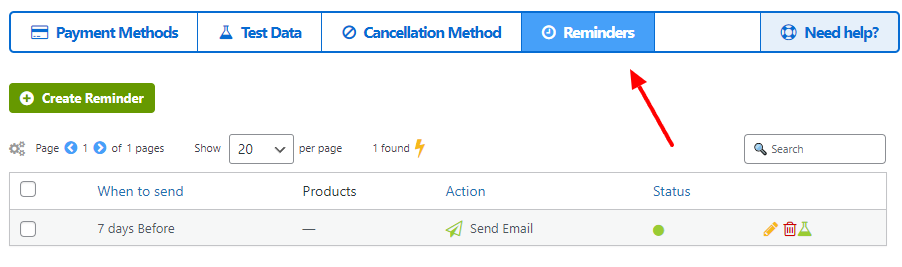
You can also set up billing reminders before the next payment. These notifications can tell members when the trial ends, how much they’ll be charged, and when the transaction will take place.
Clear reminders reduce surprise around the first regular payment. They also give members time to update their details or cancel instead of discovering the charge after it has happened.
Trial Performance Tracking
A high signup count doesn’t automatically mean the trial is working. You also need to know how many people become paying members and how long they stay.
MemberMouse reports can help you examine sales and member growth. On Pro plans and above, the Advanced Reporting Suite also includes customer lifetime value and churn and retention reports, with filters for products, membership levels, bundles, and payment types.
Giving the trial its own product or membership level makes it easier to separate those members from customers who paid the regular price immediately. You can then compare their conversion and retention results.
MemberMouse reporting focuses on membership and revenue outcomes. It won’t necessarily tell you which lesson someone completed or which page held their attention. You may need website, course, or email analytics to study those behaviours.
Together, those tools can help you answer two separate questions: what trial members did while they had access and if the experience led to lasting revenue.
Failed Payment Recovery
A member who reaches the end of a trial may be ready to stay, only for the first full-price payment to fail.
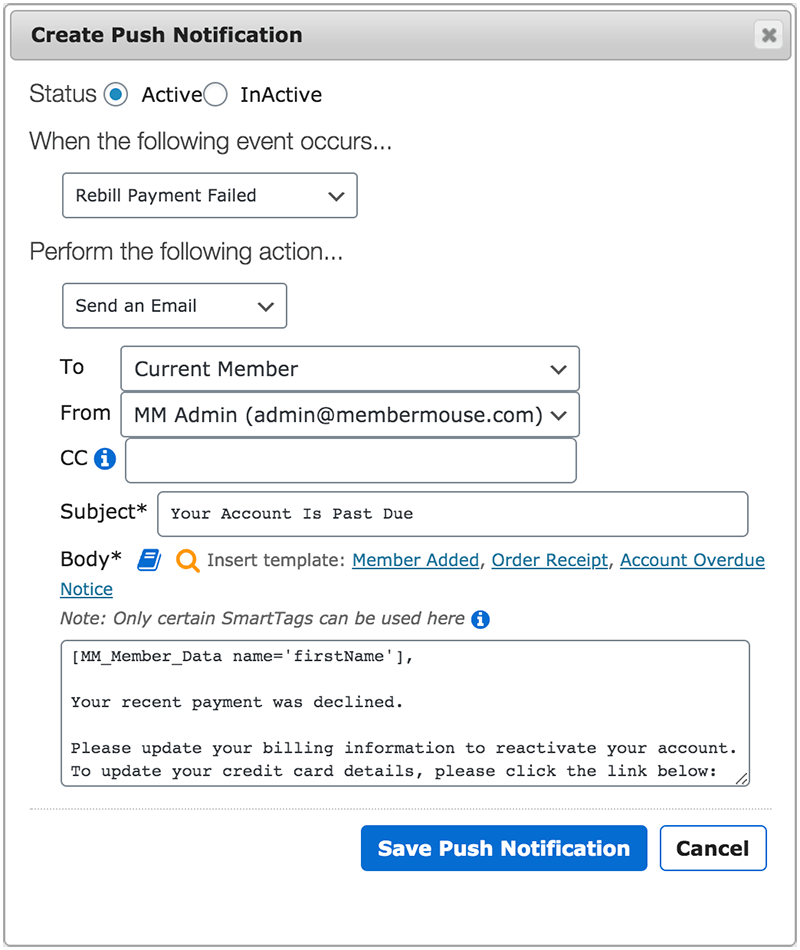
With supported card-on-file payment processors, MemberMouse can move the subscription into overdue status, block access to protected content, send payment notifications, and make further collection attempts.
By default, its automated overdue payment handling makes three additional attempts over one week. This gives members an opportunity to correct an expired card or another billing problem before their access is cancelled completely.
The process works with supported processors such as Stripe, Braintree, Authorize.Net CIM, and Sticky.io. It doesn’t work the same way with PayPal or standard Authorize.Net because those services control recurring billing outside MemberMouse. In those cases, MemberMouse responds to the payment status reported by the provider.
This distinction is worth checking before you launch. A recovery process can only protect trial conversions when your chosen payment setup supports it.
Access Control
A trial should reveal enough value to help someone make a decision without giving them unrestricted access to everything you’ve created.
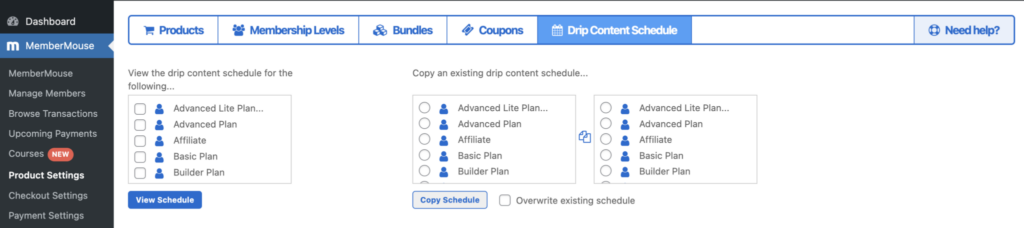
MemberMouse lets you protect WordPress pages and posts by membership level or bundle. You can also use the Drip Content Schedule to release resources at different points in the trial.
For a seven-day fitness trial, you might open the beginner workout library on day one and schedule additional programmes for later in the week. Content intended for long-term members can remain unavailable until after regular billing begins.
This approach gives the trial a clear route rather than dropping people into a large content library and expecting them to find the best starting point themselves. It also lowers the risk of someone joining briefly, downloading everything they need, and leaving before the first charge.
MemberMouse can’t decide which trial will appeal to your audience, but it gives you the controls to apply that decision. You can set the terms, guide access, prepare members for billing, recover supported failed payments, and measure if the trial is producing customers who stay.
Should You Offer a Trial Membership?
A trial may be worth offering when it gives interested prospects a lower-risk way to experience your membership and a clear reason to continue. It’s less likely to help when members can consume the main value immediately, receive little guidance after signup, or face a confusing move into paid access.
Before launching one, decide if it will be free or paid, if you’ll collect payment details, how long it will run, and which resources members can access. You’ll also need a plan for onboarding, the first regular charge, and measuring how many participants become long-term customers.
MemberMouse gives you the tools to put those choices into practice. You can create free or paid trials, release content on a schedule, prepare members for upcoming charges, recover supported failed payments, and track the results beyond the initial signup.
Explore MemberMouse’s membership and subscription features to see how the platform can support your trial from registration through recurring billing.
Have you offered a trial membership before? Share what worked, what didn’t, or what you’d do differently in the comment section below.


Sarah Olaleye
Sarah Olaleye writes about what it takes to build and grow a membership business beyond the initial launch. With experience in SEO, content marketing, WordPress, and managing online businesses, she understands the work behind attracting members, keeping them engaged, and creating reliable revenue. At MemberMouse, she helps business owners make smarter decisions about memberships, automation, and long-term growth.

 EN
EN  ES
ES  DE
DE  FR
FR  PT
PT 


